Technical Information
The basic components of ammunition are the case, primer, powder, and projectile.
- Case – The case contains the powder, primer, and bullet all enclosed in one cartridge. (generally brass, nickel, or steel).
- Primer – The primer is what is struck by the firing pin to ignite the gunpowder
- Powder/propellant – The gunpowder (propellant) is what is ignited to propel the bullet out of the cartridge
- Projectile – The bullet is the projectile that flies out of the end of the cartridge upon ignition (technically it’s the only part of the cartridge that is a bullet)

You pull the trigger and a loud bang follows. Seems pretty fast and straightforward. However, within that split-second of firing, there are several processes going on within the gun, all of which occur extremely rapidly.
When the trigger gets pulled and the primer receives the strike of the firing pin, a small spark emerges igniting the propellant.
This propellant burns rapidly, releasing gases at high pressure. By virtue of these gases, enormous pressure is exerted inside the gun.
Newton’s third law of motion states that if an object exerts an amount of force on another object, the second object retaliates by exerting an equal force in the direction of the first object’s force. This is why you feel the gun leaping backward when it fires a bullet.
So, when the propellant exerts pressure on the gun, the gun exerts an equal and opposite force on the case containing the propellant and other components including the bullet.
As the gases seek a way out, they are channeled through towards the bullet which offers a path of relatively low resistance for a breakout. The gases push the bullet out of the case and through the gun’s barrel as they escape, all accompanied by that loud bang.
Guns come with spiraling grooves within the barrel called rifling. These grooves make the emerging bullets spin as they travel through the air. Spinning makes the bullet break through resistance much more effectively, continuing in a straight path towards its target.
Although people commonly say just “.45 caliber” or “9mm” those are just measurements and are not precise descriptions of cartridges.
When most people say .45 caliber, them usually mean .45 ACP (Automatic Colt Pistol) which is the common round used in semiautomatic pistols. There are other .45 caliber cartridges, however, like the .45 Long Colt, .454 Casul, and many others.
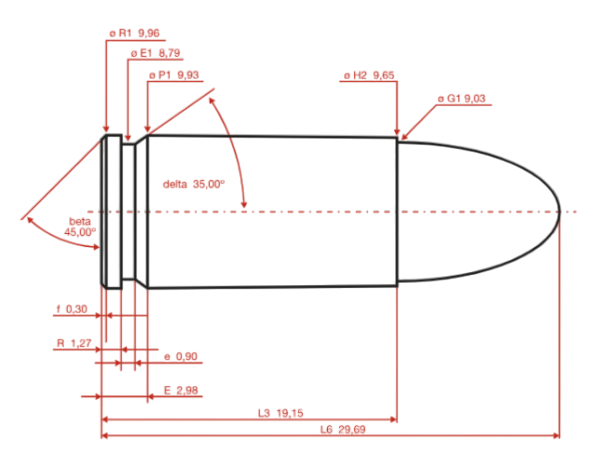
Likewise, when people say 9mm, they usually mean the 9x19mm, 9mm Luger, 9mm Parabellum cartridge, which are all different names for the same common 9mm cartridge. There are other much less common 9mm cartridges, but in the US, it is a safe bet this cartridge is what people are referring to.